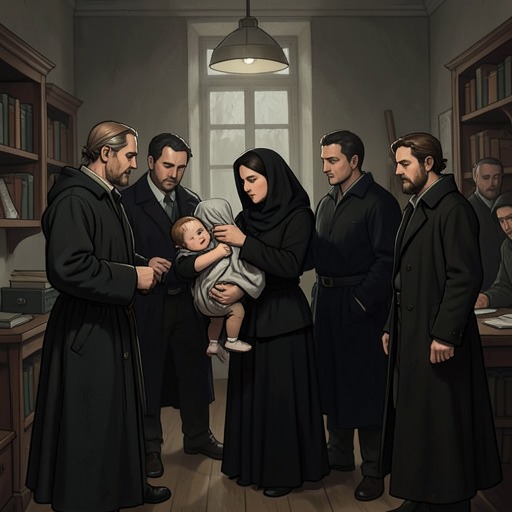
Gwynplaine's abandonment by the Comprachicos
The Man Who LaughsGwynplaine's abandonment by the Comprachicos begins the life that will make him a travelling performer and, later, a public emblem of suffering. Left on the Portland coast as a child, he was received into a poor caravan at Weymouth; the separation that exposed him to danger also led to the care of Ursus and a new place among the performers.
The Abandonment
A placard displayed before the Green Box troupe gives the abandonment a precise date and age: Gwynplaine was deserted on the night of January 29, 1690, when he was ten. The narrative identifies the Comprachicos as those who left him on the coast of Portland. Elsewhere, it confirms that the abandoned boy was received into a poor caravan at Weymouth. These details establish both the rupture and its immediate aftermath: Gwynplaine was left without his former protectors, then taken into a travelling household.
The placard turns this past event into part of the troupe’s public account of its leading performer. It announces the child’s desertion and his later name, the Laughing Man, joining an act of abandonment to the identity by which audiences know him. The transformation is not simply a change of circumstance. The face that draws crowds is presented as an imposed condition, not a natural expression: Gwynplaine’s features produce an involuntary appearance of laughter, while his own thoughts and feelings remain distinct from it.
From Castaway to Performer
As a mountebank, Gwynplaine makes a living from the effect his face has on spectators. His appearance provokes laughter even from people who arrive burdened by sadness; the response can be so powerful that mourners struggle to maintain their gravity. Yet the public reaction does not mean that Gwynplaine himself is amused. His face seems to laugh without his consent, and emotion only intensifies its fixed expression. The performance is therefore double: audiences treat his face as entertainment, while the person behind it cannot freely control the spectacle.
That public success has a cost. Once their laughter passes, spectators turn away, and women in particular shrink from looking at him. Gwynplaine is described as tall, well made, and agile, with the difference confined to his face; nevertheless, the visible mark overwhelms how others perceive him. His popularity, like his visage, functions as a mask: it brings an audience close for the show but does not secure lasting acceptance.
The performers’ life also alternates sharply between exhibition and seclusion. When the show ends, the Green Box closes off contact with the crowd, and the troupe withdraws from public view. For Gwynplaine, abandonment thus leads not to a settled place in ordinary society but to a life in which recognition is conditional: he is celebrated as an act and avoided as a person.
The Face as a Public Accusation
The narrative connects Gwynplaine’s fixed expression to an earlier intervention in his life. It presents his altered face as likely to have been deliberately fashioned when he was very young, rather than produced by nature, and notes that his lack of conscious memory would not disprove that possibility. His appearance consequently carries the history of violence beyond the moment of abandonment, although the account distinguishes what can be inferred from what Gwynplaine remembers.
That meaning becomes explicit when Gwynplaine addresses the House of Lords. He argues that a king placed the laugh on his face and makes it a symbol of the people’s condition: outward signs of cheer conceal enforced silence, rage, and suffering. He contrasts the nobles’ laughter at him with the pain his expression represents, recasting the feature that once earned him a livelihood as an accusation against those in power. The abandoned child’s history has therefore become more than a private misfortune. It shapes his public identity, his relation to spectators, and the political meaning he gives to his own appearance.